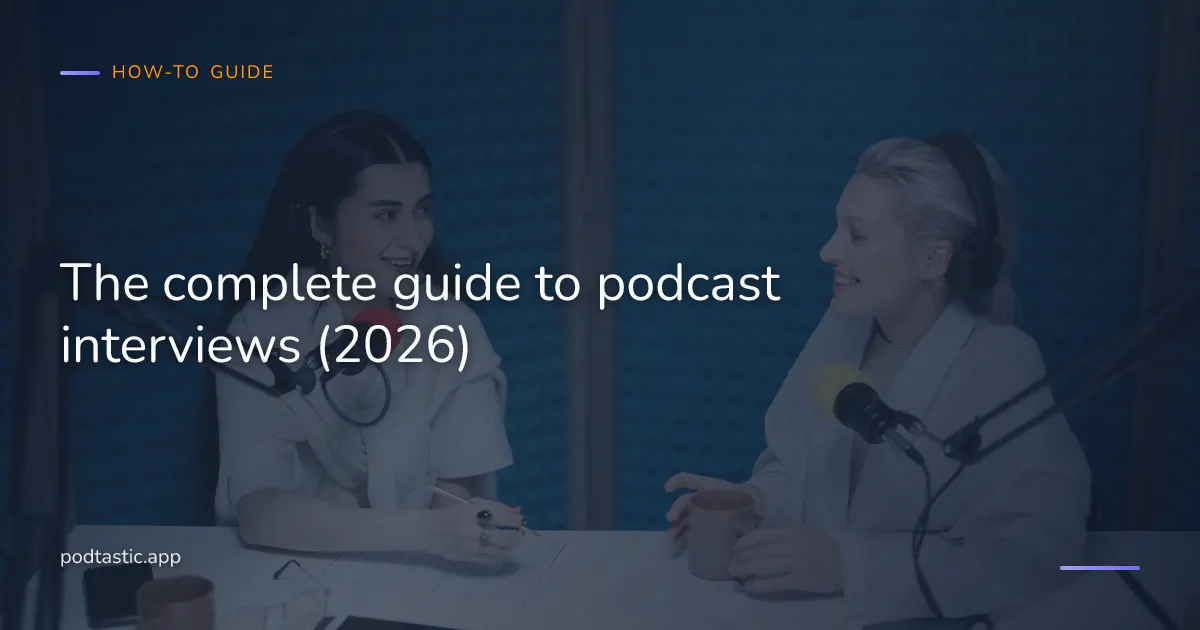
The complete guide to podcast interviews (2026)
If you added up your listening for the last year, most of it would be interviews. Interview shows are the dominant format in podcasting — a host, a guest, an hour or two of conversation about the guest's life or work. Everyone from Terry Gross to Marc Maron to Lex Fridman to your friend's cousin is doing one.
The problem is that the median interview podcast is mediocre. A host asking soft questions. A guest on a press tour telling the same three anecdotes they tell everywhere. A conversation that never gets past the surface. It's not offensive; it's just not worth the ninety minutes.
The good news is that great interview shows are easy to spot once you know the signals. And once you can spot them, you can build a rotation of three or four interview shows that consistently give you something worth the time.
This is the working guide. The signals to judge a show by in the first five minutes, the three styles of great interview, and the exemplars of each style you can subscribe to today.
Why interview shows are hard to judge from the outside
Two shows with the same guest can sound structurally identical from the episode description. Both are 90 minutes. Both list the guest's book in the title. Both have an image of two people at microphones.
Inside the episodes, they are completely different. One host has read the book and cross-referenced it against the guest's previous work; the other host has skimmed the marketing copy. One asks the annoying follow-up when the guest evades; the other moves on. One episode teaches you something you couldn't have got from the guest's Wikipedia; the other doesn't.
The way you tell them apart isn't the description. It's the first five minutes.
The five signals in the first five minutes
If you evaluate an interview show against these five signals, you'll almost always know within the intro whether the episode is worth staying for. Try this once on a show you already like — you'll recognise all five instantly. Then try it on a show you're not sure about.
1. Does the host actually know the guest's work? The clearest signal. A prepared host references a specific chapter, a specific claim from a previous episode, a specific paper. An unprepared host says "So I've read a lot about your work" and then asks a general opening question. If the host is talking about the guest at any level of detail in the first three minutes, that's a very good sign.
2. Is the host willing to disagree? Some of the best interview shows are fundamentally cooperative — the host is drawing the guest out, not challenging them. That's a real style and it can be great. But even in that style, the great hosts push back at some point. "Here's what I don't understand about that argument" is the sentence that separates a real conversation from a fireside chat with a PR handler. Listen for it, or for its absence.
3. Does the guest seem surprised at any point? A guest who is surprised is a guest who is thinking rather than performing. You can hear it — the pause, the "oh, hm, that's a good question," the shift in the pace of their speech. Guests get surprised when the host asks something they weren't briefed on. That is often the interview's best moment.
4. Is there silence? Great interviewers can tolerate silence. When a guest gives a short or evasive answer, a great interviewer waits. The guest, uncomfortable, keeps talking — and the second sentence is usually the one you were listening for. Bad interviewers fill every silence with the next question, and their guests only ever say the first sentence.
5. Does the interviewer say "we"? This is a subtle one. When a host constantly says "we" — "we should talk about this" — they're framing the show as a shared journey with you the listener. When a host says "I" a lot — "I've been thinking about" — they're framing it as their own show that you're overhearing. Neither is wrong, but the "we" hosts are usually more listener-serving and the "I" hosts are usually more idea-driven. Both can be great; you'll prefer one style.
Score a new-to-you show against these five. Four out of five, keep listening. Two out of five, it's not for you.
The three styles of great interview
Great interview shows fall into three broad camps. They ask different things of the host and of you, so I recommend having at least one show from each in your rotation.
Style 1 — Deep-prep
The host has done an unreasonable amount of homework. They've read the book twice, they've read the guest's previous three books, they've read the papers the book cites. When the conversation starts, they can already speak the guest's language.
The strength of the style is depth. You leave the episode with a genuine understanding of the guest's ideas, not just a vibe. The tradeoff is that the shows can be dense — this is not background listening. You'll want to be paying attention.
The exemplars:
- Dwarkesh Podcast — Dwarkesh Patel does the homework everyone else pretends to. When he interviews an ML researcher he speaks ML. When he interviews a physicist he speaks physics. The show is closer to a graduate seminar than a chat, and it's the best in the deep-prep category.
- The Ezra Klein Show — Klein has been doing this for over a decade and is famously well-briefed. What sets him apart is that he uses the prep to push guests toward disagreement rather than agreement. He'll say "I want to steelman the opposite view" and mean it.
If you can only listen to one deep-prep show, pick based on the topics: Dwarkesh leans AI/ML/science, Ezra Klein leans politics/policy/philosophy.
Style 2 — Host-driven, willing to challenge
The host has a strong point of view of their own. They're not neutral — they're an interlocutor with a stake in the conversation. Which means the interview is closer to a debate, and the guest has to actually defend their positions.
This is often the most exciting style to listen to, because there's genuine friction. It's also the style with the highest failure mode — a host with a POV and no discipline just talks over the guest. The good ones don't.
The exemplars:
- Hard Fork — Kevin Roose and Casey Newton have a two-hosts-one-guest format where the hosts take turns pushing back on different angles. Roose asks the reporter's questions ("but what actually happened"); Newton asks the industry-insider questions ("who at the company is furious about this"). Together they give the guest very little room to hide.
- The Louis Theroux Podcast — Theroux's whole documentary career was built on the technique of the gentle challenge — the follow-up that seems curious but isn't. He carries the style over into the podcast, and it works especially well with guests who've built a public persona they're used to defending.
The trick to this style is that "willing to disagree" is not the same as "aggressive." The best host-driven interviews sound completely friendly. The friction is in the questions, not the tone.
Style 3 — Conversational and warm
The host is not there to challenge the guest. They're there to draw them out — to give them space to think, and to reflect back what they hear, and to notice when something the guest says opens onto something bigger. The interview is closer to a good pub conversation than a debate.
The tradeoff is that these shows can meander. If you want a sharp argument, this is the wrong style. If you want to feel like you've spent an hour in the company of interesting people, this is the right style — and often what most people actually want at the end of a long day.
The exemplars:
- Wiser Than Me with Julia Louis-Dreyfus — the reason this show is great is that Louis-Dreyfus is comfortable with silence and with slowness. The guests are older women who've done interesting things; the pace is unhurried. She lets them tell the stories they want to tell.
- How I Built This with Guy Raz — the founder-story version of the same technique. The format is warm and predictable, which is why guests open up. Raz's follow-up questions are exactly the ones you'd want to ask.
- The Adam Buxton Podcast — Buxton is a comedian, so the tone is lighter than the other two on this list, but the underlying skill is the same. He's genuinely curious about his guests and prepared to spend a long time on the small stuff, which is often where the interesting stuff lives.
Conversational is the style most heavy podcast listeners overuse without noticing. If your queue is 90% conversational interviews, mix in a deep-prep show — the change of pace makes both feel better.
The failure modes to spot early
Just as useful as knowing the good signals is knowing the bad ones. Three failure modes to catch in the first five minutes:
The friend interview. Host and guest are old friends. The rapport is warm and easy, and the conversation is basically incapable of being interesting because there's no productive tension. You'll hear a lot of "haha yes, absolutely." Skip.
The book-tour interview. The guest has a book to sell. The host asks the questions in the publisher's briefing document. The guest gives the answers they've now given fifty times. You could listen to any of those fifty appearances and get the same content. Save it — read a review of the book instead.
The unprepared host. The host doesn't seem to know what the guest is famous for and asks them to introduce themselves. This is fine on a show that's designed as an introduction, but on any show that isn't, it's the sign of an under-cooked episode. Move on.
Building your rotation
If you're serious about interviews, a working rotation looks something like:
- One deep-prep show for when you want to be taught something. Dwarkesh or Ezra Klein.
- One host-driven show for when you want debate. Hard Fork or Louis Theroux.
- One conversational show for the long walk. Wiser Than Me, How I Built This, or Adam Buxton.
Three shows across three styles is enough. It gives you variety, it keeps any one style from dominating your queue, and it's a small enough set that you can actually keep up.
If you're not sure where to start, my honest advice is: pick the one from each style that most matches your current interests, and try one episode from each in the same week. You'll know immediately which two are for you.
The bigger point
Interview podcasting has been popular for two decades because a great interview is one of the highest-density formats we have for learning from someone. In two hours you can get closer to how a person thinks than a whole book might get you. Two hours is a big investment; a bad interview is a big waste of it.
The good news is that the signals of a great interview are legible in the first five minutes. If you use them, you can filter out the majority of the format and spend your listening time on the shows that actually earn it.
That's it. That's the guide.
Try Podtastic. It's an independent podcast app built for listeners, not for advertising companies. Smart Summaries make triaging an interview show fast — you can see what an episode is about in fifteen seconds. Smart Topics show you the sections of a two-hour conversation so you can jump to what you actually want. Smart Skip skips past interruptions other listeners already skipped. Skip Silence and Enhance Voices make long-form interviews easier to listen to. Download now.